

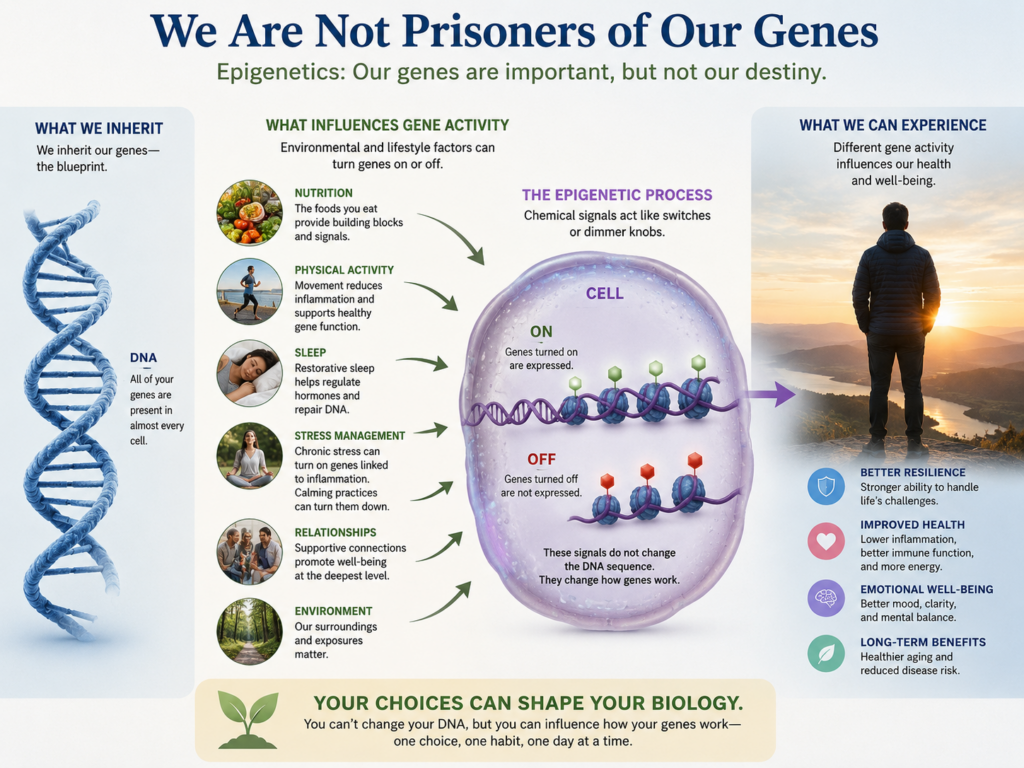
For much of my early medical training, we tended to think about genes almost as though they were instructions carved in stone. You inherited certain genes from your parents, and those genes helped determine the hand you were dealt. Genetics still matters enormously, of course, but the emerging science of epigenetics has given us a more interesting picture. Think of your DNA as the keys of a piano. The keys themselves may remain the same, but which ones are played, how often they are played, and how loudly they are played can change. Through biological mechanisms that influence gene activity, our bodies continually respond to signals associated with nutrition, exercise, sleep, stress, aging, environmental exposures, and many other aspects of life. We inherit a biological story, but that does not mean every chapter has already been written.
This reminds me of patients who would come into my office carrying not only a diagnosis but a family history. “My mother had this disease, and my father had it too, so I suppose I’m next,” they would say. I understood their fear, but I never wanted them to confuse risk with destiny. Today, epigenetics gives us another way to understand why. We cannot choose the genes we inherited, and no amount of positive thinking can guarantee that we will avoid illness, but we can participate in the environment in which our biology lives. How we nourish ourselves, whether we move our bodies, how well we sleep, how we respond to chronic stress, and the quality of the relationships surrounding us can all become part of that biological environment. To me, that is not a reason to feel responsible for everything that happens to us; it is a reason to recognize that we are participants in our well-being.
Perhaps this is the deeper lesson epigenetics offers us. We are shaped by our inheritance, but we are also living organisms continually responding to experience. I have spent much of my life encouraging people to stop asking only, “What is going to happen to me?” and begin asking, “How can I participate in my life today?” We cannot rewrite our DNA with hope, love, or a change in attitude, but we can create healthier conditions in which our bodies must live, and those conditions matter. Healing has never meant controlling every outcome. It means becoming an active partner with the remarkable biology we have been given and remembering that inheritance may influence our story without necessarily determining its ending.