

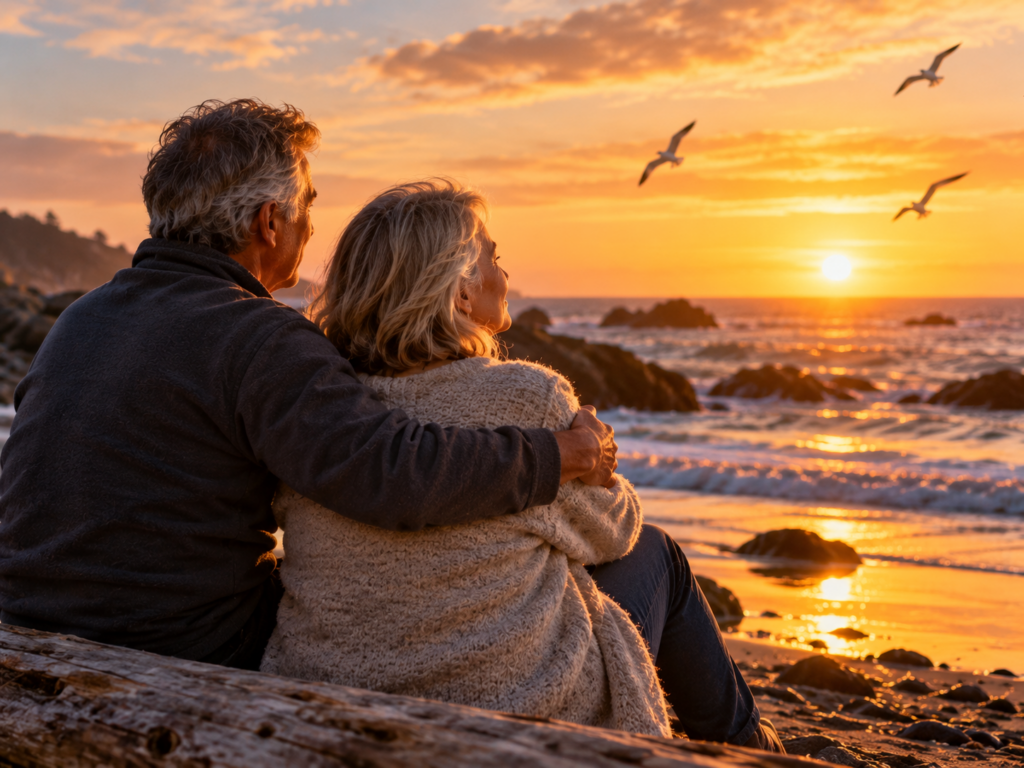
I remember a patient who had spent so many months moving between doctors, tests, treatments, and waiting rooms that illness had gradually become the landscape of her life, until one afternoon when her husband persuaded her to take a drive and they stopped beside the ocean just as the sun was beginning to set. She told me later that she stood there watching the light move across the water while gulls circled overhead, and for several minutes she forgot to be a patient. Her disease had not disappeared, but something inside her had shifted because the world had suddenly become larger than her diagnosis. I have seen that same expression on people’s faces while holding a newborn child, listening to music that reaches someplace words cannot, walking beneath enormous trees, watching snow fall in silence, or looking into a night sky crowded with stars. We call the feeling awe, but I sometimes think of it as the moment when life reminds us that we belong to something far greater than whatever problem has temporarily occupied the center of our attention.
Scientists have become increasingly interested in experiences of awe and wonder, with research suggesting that these moments can influence stress, emotional well-being, social connection, and even some biological processes associated with health, although we should be careful not to turn wonder into another treatment or promise. To me, the deeper lesson is that awe changes our perspective. When we are frightened or overwhelmed, our world can become very small, with our attention circling endlessly around symptoms, appointments, bills, losses, and uncertainty, but wonder interrupts that circle and opens a window. For a moment we are not asking, “What is wrong with me?” because we are too busy noticing what is beautiful, mysterious, or astonishing around us, and that shift from self-preoccupation toward connection may be one of the gentlest ways we can give the nervous system a little rest from constantly guarding against what might happen next.
The wonderful thing about awe is that we don’t need to climb a mountain or stand at the edge of the Grand Canyon to experience it, because life offers small miracles everywhere when we remember how to look. I have found wonder in children’s questions, animals who somehow know when we need comforting, the resilience of a flower pushing through a crack in the pavement, and the extraordinary fact that after a surgeon closes an incision, the body quietly begins repairing itself without being told how. Perhaps self-induced healing sometimes begins with something as simple as lifting our eyes from what frightens us and becoming curious again about the world, because awe does not ask us to deny suffering; it reminds us that suffering is not the whole of life. Sometimes healing begins when we stop asking life to explain itself and allow ourselves, for a few precious moments, simply to be amazed by it.